Winter just happened. Luckily, last week I drilled a 4″ hole in the floor of the van and installed a heater than runs on diesel from the van’s fuel tank. Continue reading “Toasty warm diesel heat”
Toasty warm diesel heat


Building the Escape Pod
Winter just happened. Luckily, last week I drilled a 4″ hole in the floor of the van and installed a heater than runs on diesel from the van’s fuel tank. Continue reading “Toasty warm diesel heat”

We plugged a phone charger into the cigarette lighter socket in the front of the van. It’s a 25 Amp socket. The end broke off the charger inside the socket. A fuse saved us from a potential melt-down.
25 amps of short-circuiting 12 volt electricity creates a lot of heat. If the fuse hadn’t blown, by the time we’d realized there was a problem and disconnected the battery there might not have been much left of the central console in the dash.
Mercedes did a nice job of protecting their electrical system. We decided to do an equally safe job of the electrical stuff we added to the vehicle. Continue reading “Fuses will save your van (and maybe you too)”

It helps to know how full or empty your battery is. In the same way that you wouldn’t drive without a fuel gauge, you shouldn’t use a battery without some form of monitoring.
Lead batteries last longest if they are always kept above 50% of their capacity. Lithium batteries last longest if they are kept above 30% of their capacity. Abusing batteries by discharging them too far seriously shortens their useful life. The cost of a battery monitor works out to be much less than the cost of a new battery.
There are lots of monitors out there. Several of them are great demonstrations of what happens when you let engineers specify the design. They do their job (some very well) but they look horrible and their interface is terrible to configure. Continue reading “Knowing how much juice your battery has”
The almost 800 Watts of solar panels on the van did a great job charging the battery on our recent trip. The charger took a little bit of custom configuration, but the menus were easy enough to work with and now everything works well.
I started off with the default charge controller settings for a Lithium battery, but once the battery got close to full, the charger made the battery management system upset. The BMS wanted 13.5 volts float charge, the charger was producing 13.8. Not enough to hurt the battery in the short term, but something that I needed to take care of. If nothing else, I wanted to stop the BMS light from coming on!

Horse stall mat, vinyl coin matting and closed cell foam make a good sound damping combination over the factory wood floor of the van. Flanged l-track holds the three layers in place.
Continue reading “Adding sound and heat insulation to the floor”
Our van will have different ‘zones’ inside – a garage area for bike storage, a bed area, a living area and a driving area. One way to differentiate these is by changing the wall covering in each area.
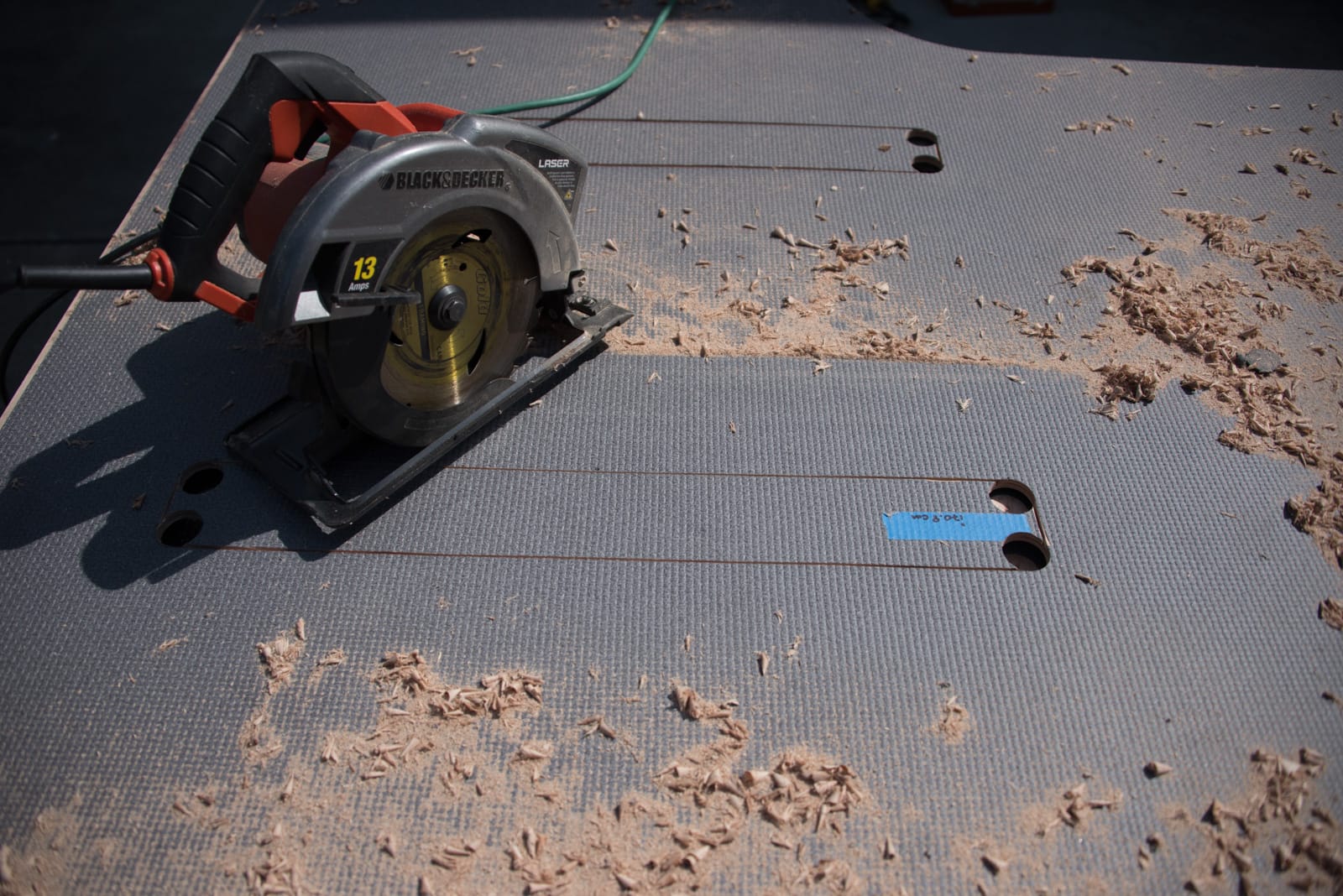
We moved the passenger seats towards the back of the van, and added l-track to hold down an additional floor layer on top of the factory floor. That meant several big changes to the factory wood floor insert.

We need a way to recharge the battery from “shore power.” That means mains outlets attached to the house. The easiest way is to run an extension cord through an open door, but that’s not very elegant, secure, or warm.

We’ll be putting removable cabinets in the front of the van. We knew pretty much what size they needed to be in order to hold the items we want to carry, but we didn’t know what that meant for maneuverability in the living area of the van.
So, I resorted to a tool I use in my day job – paper prototyping. We’d already done this to work out the best configuration for the electrical components in the garage area of the van. Now, we just needed bigger cardboard boxes and more tape in order to make real-size mock-ups of the cabinets. Continue reading “Mocking up cabinet locations”

Logistic track (also called l-track or airline track) is an extruded aluminum strip that has holes drilled through it at 1″ intervals, and an inverted “T” cross-section cut out through its length. Connectors slide in through the holes and then lock in place with a spring or a bolt. That makes it easy to configure to support any load you want to carry. Continue reading “Logistic Track – the super-connector”